
Number of visitors on page:
Product visitors:
10.00€
Share:
Biblioteka
Edition IWA BOGDANI
iwabogdani@gmail.com
IWA Bogdani, Brussels – Prishtinë
0032494464251
Autor: Sultan Catto
Redaktor:
Xhemil Bytyçi
Përktheu nga Anglishtja: Jeton Kelmendi
Dizajni i brendshem: Bogdani Design
Ballina: IWA Bogdani
Ballona: IWA Bogdani
Copyright © – Sultan Catto and IWA Bogdani
ISBN 978-9951-394-71-0
Nga Prof. Jeton Kelmendi
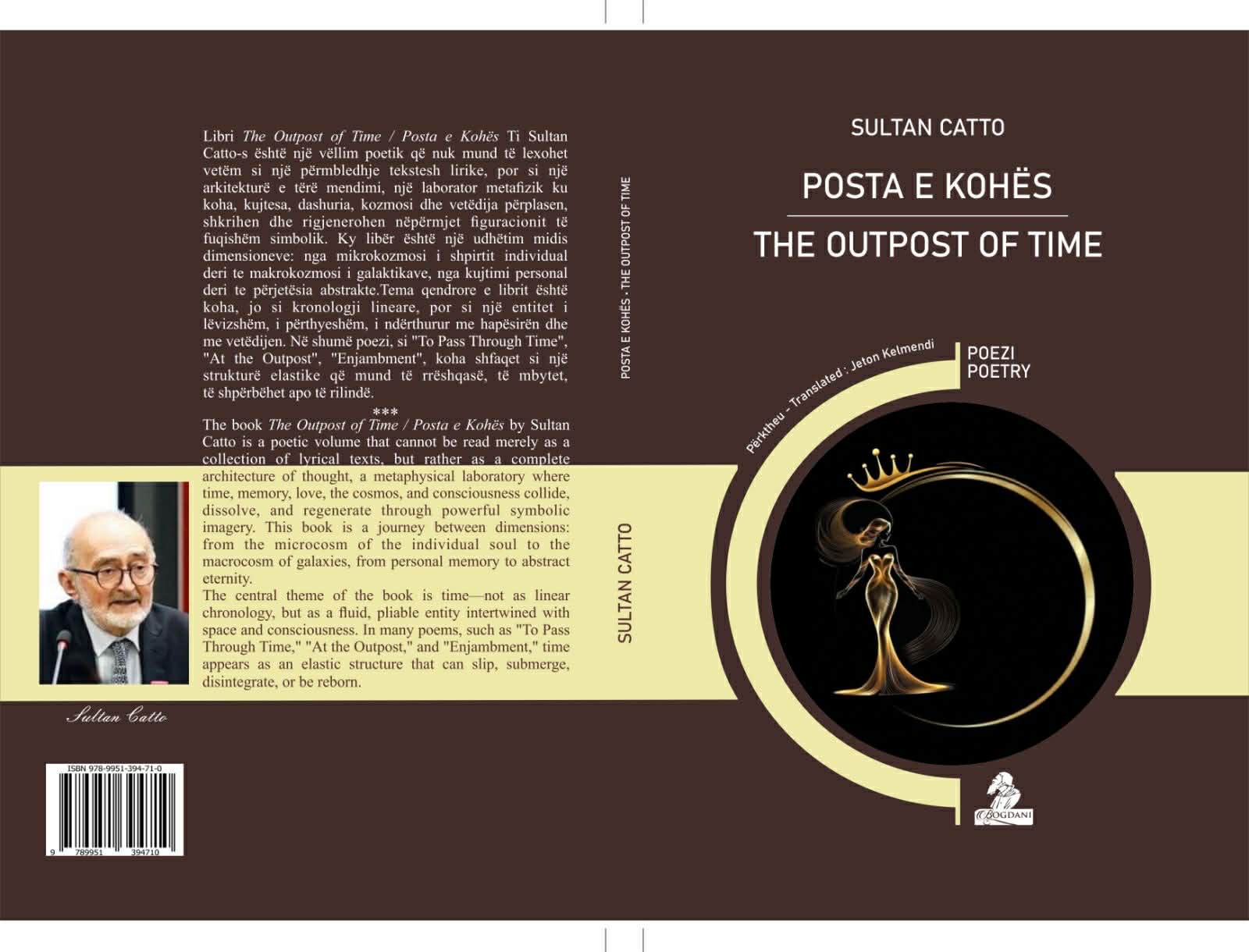
Libri The Outpost of Time / Posta e Kohës i Sultan Catto-s është një vëllim poetik që nuk mund të lexohet vetëm si një përmbledhje tekstesh lirike, por si një arkitekturë e tërë mendimi, një laborator metafizik ku koha, kujtesa, dashuria, kozmosi dhe vetëdija përplasen, shkrihen dhe rigjenerohen nëpërmjet figuracionit të fuqishëm simbolik. Ky libër është një udhëtim midis dimensioneve: nga mikrokozmosi i shpirtit individual deri te makrokozmosi i galaktikave, nga kujtimi personal deri te përjetësia abstrakte.
Tema qendrore e librit është koha, jo si kronologji lineare, por si një entitet i lëvizshëm, i përthyeshëm, i ndërthurur me hapësirën dhe me vetëdijen. Në shumë poezi, si “To Pass Through Time”, “At the Outpost”, “Enjambment”, koha shfaqet si një strukturë elastike që mund të rrëshqasë, të mbytet, të shpërbëhet apo të rilindë. Ajo nuk është thjesht një rrjedhë, por një terren ku shpirti kërkon kuptim. Poezia nuk e trajton kohën si armike, ajo e trajton si një stacion tranzitor, si një “postë” ku njeriu ndalet për të reflektuar mbi të shkuarën, për të imagjinuar të ardhmen dhe për të përjetuar intensitetin e së tashmes. Kujtesa shpesh paraqitet si një pjerrësi: herë pozitive që të ngre drejt yjeve, herë negative që të rrëshqet në oqeanet e ëndrrave. Kjo metaforë gjeometrike e kujtesës tregon se poeti e ndërton përvojën ekzistenciale mbi një fushë dinamike forcash. Një tjetër temë madhore është bashkimi kozmik dhe dashuria e përfytyruar si bashkim yjesh, si vrimë e zezë, si energji termodinamike. Në poezinë “Bonding”, dy shpirtra përfytyrohen si dy yje gjigantë që rrotullohen rreth njëri-tjetrit dhe shndërrohen në një njësi kozmike. Dashuria këtu nuk është thjesht ndjenjë, por ajo është fenomen astronomik.
Vargu i Sultan Catto-s është i lirë, pa metër tradicional, por me një ritëm të brendshëm që buron nga përsëritjet, nga strukturat sintaksore të zgjeruara dhe nga ndërthurja e imazheve. Ai përdor shpesh enjambement-in, (Kapërcimin) duke lejuar mendimin të rrjedhë përtej kufijve formalë të vargut. Kjo teknikë i jep poezisë një ndjesi rrëshqitjeje, një lëvizje të vazhdueshme që pasqyron vetë konceptin e kohës si rrjedhë e pambarimtë. Figura letrare është e ngarkuar me metafora kozmike, fizike, muzikore. Termat si “space-time fabrics”, “black hole”, “thermodynamic disorder”, “constellations”, “cumulonimbus” nuk janë thjesht elemente dekorative; ato krijojnë një gjuhë hibride ku shkenca dhe mistika bashkëjetojnë. Ky bashkim i diskursit shkencor me atë poetik i jep tekstit një thellësi moderne, një rezonancë bashkëkohore. Muzikaliteti i vargut shpesh mbështetet në përsëritje konceptuale (“If only… If…”) që krijojnë efekt meditativ, pothuajse mantrik. Poeti shpesh i kthehet heshtjes si element strukturor, ndërsa muzika që shpik heshtjen, fjalët që flenë mbi sexhade të hollë, zëri që zhduket për të lindur sërish në natë. Heshtja bëhet një formë e lartë komunikimi.
Qasja poetike e librit është thellësisht mistike, por jo në kuptimin dogmatik fetar. Kjo qasje është një mistikë e përvojës së brendshme. Figura e dervishit, e murgu sufi, e shamanit, e poetit që endet në kozmos janë metafora të kërkimit shpirtëror. Poeti nuk kërkon të japë përgjigje, thjeshtë, ai kërkon të udhëtojë në pyetje. Në shumë poezi, subjekti lirik është në kërkim të një “syri të tretë”, të një shikimi të brendshëm që e çon përtej realitetit të dukshëm. Ai dëshiron të “kalojë nëpër kohë”, të migrojë mes shtresave të hapësirë-kohës, të ndërtojë fyell nga kallamishtet e kujtesës. Kjo qasje e vendos librin në një traditë të poezisë filozofike ku përvoja individuale shndërrohet në reflektim universal.
Një dimension i rëndësishëm është ndërdisiplinariteti. Poezia përfshin referenca muzikore (Coltrane, saksofoni, progresionet harmonike), fizike (vrima e zezë, rezonanca), matematikore (referenca për implikimet e matematikës), mitologjike (Andromeda, sferat qiellore). Kjo e bën tekstin një hapësirë dialogu mes disiplinave – një poezi që nuk mbyllet në vetvete, por që hap dritare drejt dijes.
Në thelb, libri trajton dilemën ekzistenciale të njeriut: si të jetojë midis hijes dhe dritës. Në poezinë “Under the Exile of Shadows”, subjekti lirik pranon se njeriu duhet gjithmonë të ketë hije dhe dritë. Ky dualitet është themelor: asgjë nuk merr formë pa kontrastin e saj. Shpesh, subjekti përshkruhet si një busull, si një trumpetë e vjetër, si një flamur në mes të stuhisë. Ai është i brishtë, por njëkohësisht i vetëdijshëm për dimensionin e tij kozmik. Ai është “kukullari dhe kukulla” – krijuesi dhe krijesa, autori dhe personazhi i vetes. Ky vetëdijësim për rolin e dyfishtë e bën librin një reflektim mbi aktin krijues.
Në poezinë “Passing the Torch”, pasqyra bëhet simbol i introspeksionit. Ajo nuk është vetëm objekt reflektimi, por instrument transformimi. Poeti e ofron pasqyrën lexuesit – një gjest etik, një thirrje për vetë-njohje. Kjo e kthen librin në një dialog midis autorit dhe lexuesit.
Edhe pse libri është i ngarkuar me metafora kozmike, ai nuk e humb dimensionin emocional. Nostalgjia, humbja, kujtimi i të dashurës, aroma që mbetet mbi divan janë elemente konkrete që e rrënjosin poezinë në përvojën njerëzore. Kozmosi nuk është arratisje nga jeta; është zgjerim i saj. Dashuria shpesh shfaqet si energji transformuese. Ajo e çon subjektin nga gjendja e shpërbërjes në një bashkim të ri, nga fragmentimi në unitet. Edhe kur përjetimi është i dhimbshëm, ai mbetet krijues.
Kjo e bën librin një vepër me thellësi filozofike dhe rezonancë universale, një poezi që kërkon jo vetëm të lexohet, por të meditohet.
By Jeton Kelmendi
The book The Outpost of Time / Posta e Kohës by Sultan Catto is a poetic volume that cannot be read merely as a collection of lyrical texts, but rather as a complete architecture of thought, a metaphysical laboratory where time, memory, love, the cosmos, and consciousness collide, dissolve, and regenerate through powerful symbolic imagery. This book is a journey between dimensions: from the microcosm of the individual soul to the macrocosm of galaxies, from personal memory to abstract eternity.
Thematic Concept: Time as Spiritual Space
The central theme of the book is time—not as linear chronology, but as a fluid, pliable entity intertwined with space and consciousness. In many poems, such as “To Pass Through Time,” “At the Outpost,” and “Enjambment,” time appears as an elastic structure that can slip, submerge, disintegrate, or be reborn. It is not merely a flow, but a terrain where the soul seeks meaning. Poetry does not treat time as an enemy; rather, it approaches it as a transitional station, an “outpost” where one pauses to reflect on the past, imagine the future, and experience the intensity of the present.
Memory often appears as an incline—at times positive, lifting one toward the stars; at other times negative, sliding into the oceans of dreams. This geometric metaphor of memory reveals that the poet constructs existential experience upon a dynamic field of forces. Another major theme is cosmic union and love envisioned as the merging of stars, as a black hole, as thermodynamic energy. In the poem “Bonding,” two souls are imagined as giant stars orbiting one another, eventually transforming into a single cosmic unit. Love here is not merely emotion—it is an astronomical phenomenon.
The Style of the Verse: Structural Freedom and Inner Musicality
Sultan Catto’s verse is free, without traditional meter, yet sustained by an internal rhythm born of repetition, expanded syntactic structures, and interwoven imagery. He frequently employs enjambment, allowing thought to flow beyond the formal boundaries of the line. This technique gives the poetry a sense of glide, a continuous movement reflecting the very concept of time as an endless current. The figurative language is rich with cosmic, physical, and musical metaphors. Terms such as “space-time fabrics,” “black hole,” “thermodynamic disorder,” “constellations,” and “cumulonimbus” are not merely decorative; they create a hybrid language in which science and mysticism coexist. This union of scientific and poetic discourse grants the text a modern depth and contemporary resonance.
The musicality of the verse often relies on conceptual repetition (“If only… If…”) that creates a meditative, almost mantra-like effect. Silence becomes a structural element: music that invents silence, words that sleep upon delicate prayer rugs, a voice that disappears only to be reborn in the night. Silence becomes a higher form of communication.
Poetic Approach: Mystical, Philosophical, and Interdisciplinary
The book’s poetic approach is profoundly mystical, though not in a dogmatic religious sense. It is a mysticism of inner experience. The figures of the dervish, the Sufi monk, the shaman, the poet wandering through the cosmos—all serve as metaphors for spiritual quest. The poet does not seek to provide answers; he seeks to journey through questions. In many poems, the lyrical subject searches for a “third eye,” an inner vision that transcends visible reality. He longs to “pass through time,” to migrate between layers of space-time, to build a flute from the reeds of memory. This approach situates the book within the tradition of philosophical poetry, where individual experience transforms into universal reflection.
An important dimension is interdisciplinarity. The poetry includes musical references (Coltrane, the saxophone, harmonic progressions), physical concepts (black holes, resonance), mathematical implications, and mythological allusions (Andromeda, celestial spheres). The text thus becomes a space of dialogue between disciplines—a poetry that does not enclose itself, but opens windows toward knowledge.
Profound Thought: Existence Between Light and Shadow
At its core, the book addresses the existential dilemma of human beings: how to live between shadow and light. In the poem “Under the Exile of Shadows,” the lyrical subject acknowledges that one must always possess both shadow and light. This duality is fundamental; nothing takes shape without contrast.
The subject is often described as a compass, an old trumpet, a flag amid a storm. He is fragile, yet aware of his cosmic dimension. He is both “puppeteer and puppet”—creator and creation, author and character of himself. This awareness of a dual role renders the book a reflection on the creative act itself.
In “Passing the Torch,” the mirror becomes a symbol of introspection. It is not merely an object of reflection, but an instrument of transformation. The poet offers the mirror to the reader—an ethical gesture, a call to self-knowledge. The book thus becomes a dialogue between author and reader.
The Emotional Dimension: Nostalgia and Love
Although the book is laden with cosmic metaphors, it does not lose its emotional depth. Nostalgia, loss, the memory of a beloved, the lingering scent upon a sofa—these concrete elements root the poetry in human experience. The cosmos is not an escape from life; it is its expansion. Love frequently appears as transformative energy. It moves the subject from disintegration to new union, from fragmentation to unity. Even when the experience is painful, it remains creative.
As someone whose entire life has been bound to poetry and poetics, and above all as a devoted reader, I can affirm with conviction that Posta e Kohës by Sultan Catto transcends the boundaries of a traditional poetic book. It is a poetic treatise on time, existence, and the search for meaning. With its rich metaphorical language, free and meditative verse, mystical and interdisciplinary approach, the book creates a universe in which humanity confronts infinity without losing the intimacy of the soul. In this work, the poet is not merely a narrator; he is a cosmic traveler, a shaman of the word, a tailor of shadows, and a conductor of darkness. Time is not simply passage—it is a station where the soul pauses to reflect, to bend, to be reborn.
This makes the book a work of philosophical depth and universal resonance—a poetry that seeks not only to be read, but to be contemplated.
Prishtina, February 26, 2026
Katalogimi në botim – (CIP)
|
821.111-1
Catto, Sultan The outpost of time : poetry = Posta e kohës : poezi / Sultan Catto ; përktheu nga anglishtja Jeton Kelmendi. – Prishtinë : IWA Bogdani, 2026 . – 171 f. ; 21 cm. – (Biblioteka “Adem Shkreli”)
1. Kelmendi, Jeton
ISBN 978-9951-394-71-0 |
Biblioteka Kombëtare e Kosovës “Pjetër Bogdani”